
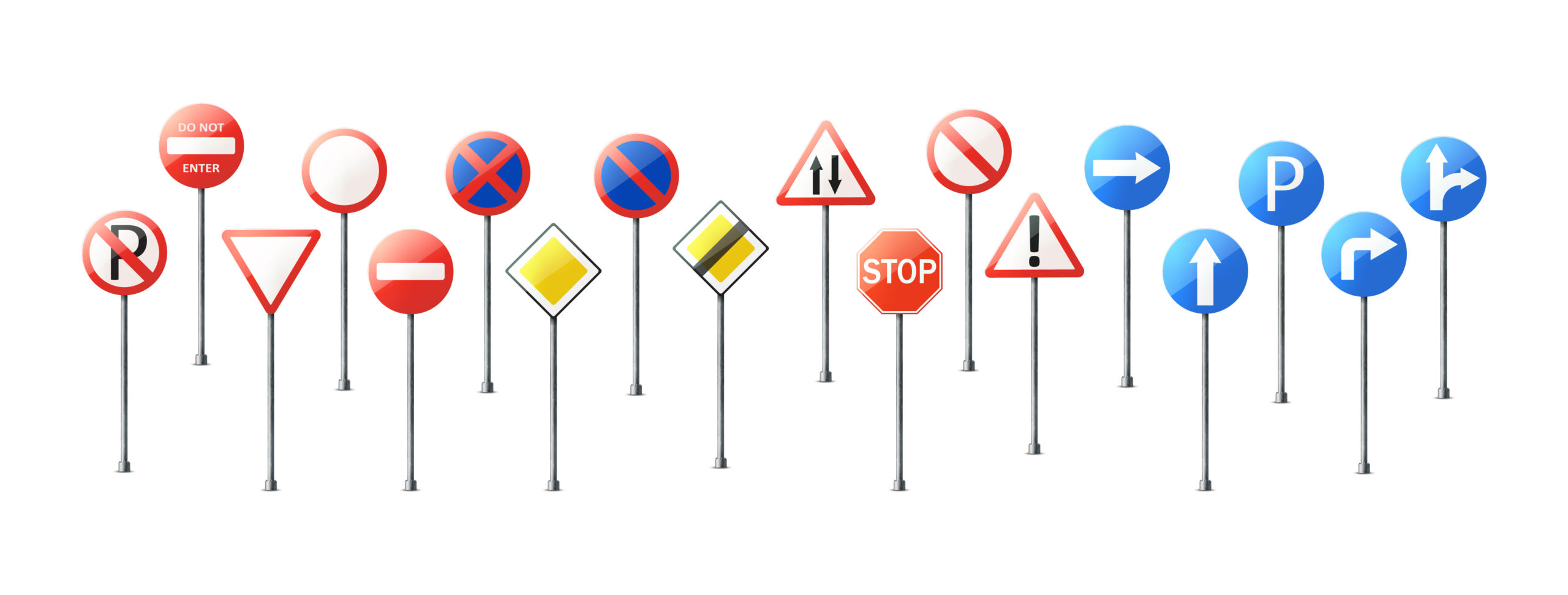

Road signs are a fundamental element of road safety and communication between road users. They convey important information through the shape and colour of road signs, warnings and instructions that drivers must perceive quickly and without hesitation. That is precisely why the shape and colour of road signs are not random – they are clearly defined by international and national regulations, including Regulation No. 18 on road signage with traffic signs, applicable throughout the territory of Bulgaria, as well as BDS EN 12899-1.
In this article, we will examine the meaning of the shape and colour of road signs across different groups, what standards apply in Bulgaria, and why compliance with them is key for any organisation involved in road signage.
1. The shape of road signs – a universal language of the road
Round signs
The round shape is most often reserved for regulatory signs, such as:
-
Prohibitory signs – a red circle with white or black content (e.g., no entry, no overtaking).
-
Mandatory signs – a blue circle with a white symbol (e.g., compulsory straight ahead).
The round shape signals to the driver that a specific rule must be obeyed, without room for interpretation. This facilitates instant perception, even at high speed.
Triangular signs
An equilateral triangle pointing upwards is used for warning signs. These indicate:
-
The presence of danger (bends, landslides, road narrowing, etc.).
-
Changes in road conditions (icy road, animals on the road, etc.).
This shape is adopted because it naturally attracts attention, even when the driver is not looking intently at the sign.
Rectangular and square signs
Informative signs are most often rectangular or square. They provide:
-
Information about the road network (e.g., exits, directions, petrol stations).
-
Road conditions and indications (parking, start/end of built-up area, etc.).
The shape suggests that it is not a regulatory or dangerous situation, but navigational assistance.
Octagon – “Stop” sign
The only octagonal road sign is “STOP”. The shape and colour of road signs is internationally recognised, unique, and signals an absolute necessity to stop – even in poor visibility.
2. Colour symbolism in road signs
Colour is a key element in perceiving the sign and plays a critical role in its meaning, priority, and impact.
Red – prohibition, restriction, caution
The colour red is used for:
-
Framing prohibitory signs – instantly attracts attention.
-
The symbol for stop.
-
Warning of danger (in combination with a white background and black symbol).
The colour red creates an automatic association with stopping or danger – this is based on human psychophysiology.
Blue – compulsory direction or information
Blue road signs can be:
-
Round – indicating mandatory actions (e.g., compulsory left turn).
-
Rectangular – indicating road directions, lanes, motorways, etc.
The colour blue suggests institutional and official information, without an element of threat.
Yellow – temporary organisation or heightened caution
It is used for:
-
Temporary road signs during repairs, detours, and temporary signage.
-
Signs indicating new or non‑standard conditions.
A yellow background immediately signals that attention should be increased, as conditions may change suddenly.
Green – navigational information
On motorways and expressways, green signs direct to exits, locations, and destinations. They are associated with route orientation, without regulatory value.
3. Standards and regulations in Bulgaria
In Bulgaria, road signs must comply with the following standards:
-
BDS EN 12899-1 – sets requirements for permanent road signs.
-
Regulation No. 18 of 2001, issued by the Ministry of Regional Development and Public Works.
-
The technical requirements of the Road Infrastructure Agency and municipal transport directorates.
The shape and colour of road signs cannot be arbitrarily chosen by the manufacturer – they are subject to strict control. Companies like SignalPro supply certified signs with guaranteed compliance with all regulations.
4. Why is this important for road safety?
Incorrect use of colours or shapes can lead to:
-
Misinterpretation by drivers.
-
Delayed reaction in a risky situation.
-
Fines and rejection by control authorities.
Choosing certified road signs with the correct shape and colour is not just an administrative concern – it is a matter of life and health.
5. Local context: Road signage in Bulgaria
In different parts of Bulgaria – Sofia, Plovdiv, Varna, Burgas, Stara Zagora – there are various traffic situations where the shape and colour of the sign are crucial.
Example:
-
In capital city traffic with complex intersections and intense traffic, clear visual messages are key.
-
In small settlements, where signage is often renewed, clearly distinguishable colours aid faster orientation.
That is why more and more municipalities choose partners like SignalPro, who offer high-quality certified signs tailored to the geographical and infrastructural specifics.
The shape and colour of road signs are an integral part of their function and effectiveness. They create a universal safety language that all road users must recognise without error. To ensure that your signage complies with Bulgarian and European standards, always choose certified suppliers and established manufacturers.
SignalPro offers you a complete range of road signs with correct shape, colour, reflectivity and installation, complying with all requirements of Regulation No. 18 and BDS EN 12899-1.

