

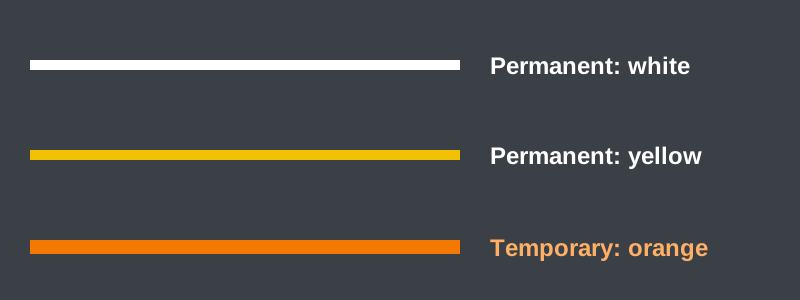
Temporary road marking is the marking applied to the carriageway during construction and installation work lasting more than one month. In Bulgaria it is recognised by its orange colour, while permanent marking is white or yellow.
This article is for clients, construction companies, municipalities and site managers who need to put an approved scheme in place on site. You will see what the Bulgarian regulation requires, which materials are allowed, how temporary road marking is applied and removed, and which mistakes come up most often.
What is temporary road marking
Ordinance No. 2 of 2001 on road signalling with road marking divides carriageway marking into two types: permanent and temporary (Art. 4, para. 1). Under Art. 5, temporary road marking is used to introduce temporary traffic organisation and safety during construction and installation work lasting more than one month, and it is orange.
In other words, it is not a stand-alone measure but part of a larger scheme. The ordinance refers to Ordinance No. 3 of 2010 on temporary traffic organisation and safety during construction and installation work on roads and streets. Orange lines are therefore planned together with temporary signs, cones and barriers, not after them. We describe how the scheme itself is prepared and approved in our article on temporary traffic management.
How to recognise temporary road marking by its colour
Colour is the only reliable sign for the driver. When white and orange lines are on the asphalt at the same time, the driver can see at once which layout is new. This is what the ordinance says about each colour:
| Colour on the carriageway | What it means | Legal basis |
|---|---|---|
| White | Permanent marking: lines, arrows, pedestrian crossings | Art. 4, para. 2 |
| Yellow | Permanent marking for areas where stopping and parking are prohibited and for public transport lanes | Art. 4, para. 3 |
| Orange | Temporary road marking during construction and installation work | Art. 5 |
| Red base | Not a line, but a base under a white pedestrian crossing in selected places | Art. 4, para. 5 |
In older materials you may come across light blue as the colour of temporary marking. It comes from the 1975 ordinance, which no longer applies.
When orange marking is needed
The threshold in Art. 5 is clear: work lasting more than one month. Typical cases are resurfacing one lane while traffic continues, shifting lanes around an excavation, narrowing the carriageway while networks are built, and detour sections around a construction site.
For shorter work, traffic is usually guided with signs, cones and channelling elements. What exactly applies to a given section is not for the contractor alone to decide, however. It is set in the approved project, so check the scheme before ordering materials.
It also matters what happens when signals conflict. Under Art. 7 of the Road Traffic Act (in Bulgarian), when signs and marking differ, drivers follow the signs, and a sign on a portable stand placed on the carriageway takes priority over other signs. So a well placed orange line helps, but it does not replace temporary signs.
Which materials are allowed
Art. 7, para. 7 of Ordinance No. 2 names two options for orange marking: paints with reflective beads or tape that complies with BDS EN 1790. In both cases, the material must be removable once it is no longer needed, without leaving traces on the pavement.
| Criterion | Paint with reflective beads | Tape to BDS EN 1790 |
|---|---|---|
| Application | By machine or stencil, needs drying time | Bonded to a prepared pavement |
| Removal | A method that leaves no traces must be planned | Removed mechanically if the tape is chosen for the pavement |
| What to check | Colour, beads, compatibility with the pavement | Compliance with BDS EN 1790 and manufacturer’s documents |
The ordinance also sets specific visibility requirements. At the start of service, the night visibility of temporary marking must be at least class R5 for the higher-category roads under Art. 7, para. 4, and at least class R3 for other roads and streets. The allowances for lower classes under Art. 7, para. 12 explicitly do not apply to it. Ask your supplier for the declared performance data, not just for “orange paint”.
In the Signal Pro range you will find orange acrylic paint and glass beads for road marking, as well as other road marking paints. Before ordering, send us the road class and the project requirements so we can check that the material fits your exact case.
5 rules for applying temporary road marking
- Start from the approved project. The geometry, lengths and positions of the lines come from the temporary traffic scheme. Changing them on site without agreement also changes the liability after an incident.
- Choose the material by duration and road. Consider how long the marking will stay, how heavy the traffic is and which night visibility class is required. Think now about how you will remove it.
- Prepare the pavement. The surface must be clean and free of grease and dust. On damp or dirty asphalt, both paint and tape hold less well.
- Apply beads to the still wet paint. Beads are spread on top and not mixed into the paint, because mixing makes them lose their reflective effect. Without them, the line looks fine by day but can hardly be seen in the evening.
- Remove it without traces. When the work is finished, remove the orange marking and restore the permanent layout if it was erased or damaged. Old lines on the asphalt mislead drivers long after the site is finished.
Beyond these five rules, check the marking throughout the project. Heavy vehicles and winter clearing wear it out quickly, especially where vehicles change lanes.
What we see in practice
In our work with municipalities and construction companies we see the same thing again and again: materials for temporary road marking are often ordered at the last moment, after the rest of the equipment is already on site. The choice is then made by availability rather than by the project requirements.
The second common question is whether white or yellow paint can replace orange if it is at hand. It cannot. Colour is what distinguishes the temporary layout, and Art. 5 states it explicitly. The third thing worth considering early is the end of the project. Removal is a separate job, so include it in the initial quote and schedule.
Do not underestimate the night check either. A layout that looks clear at noon can be confusing in the dark, in rain or against headlights. After application, drive through the section after dark in both directions. This is the quickest way to see whether the lines lead smoothly through the narrowing and whether old white lines show more clearly than the orange ones.
Checklist before opening to traffic
| Check | What must be in place |
|---|---|
| Documents | The temporary traffic scheme is approved and available on site |
| Colour | All new lines are orange |
| Old lines | Permanent lines that conflict with the scheme do not mislead drivers |
| Night visibility | Beads or tape of the required class are in place and checked in the dark |
| Signs | Temporary signs match the lines and are placed according to the project |
| End of the project | A responsible person and a removal method without traces are defined |
If the site also includes a narrowing of the carriageway, see which temporary traffic management equipment you need and how to choose the right traffic cones.
When you change the layout in stages, for example when moving from one half of the carriageway to the other, treat each stage as a separate check. Temporary road marking left on the asphalt from the previous stage misleads drivers just as much as an old permanent line.
Common problems with temporary road marking
| Problem | Cause | Solution |
|---|---|---|
| The line cannot be seen at night | Beads are missing or mixed into the paint | Spread beads on the wet paint and check in the dark |
| The paint peels off quickly | Dust, grease or moisture on the pavement | Clean and dry the surface before application |
| Drivers follow the old lines | Permanent marking stays visible | Decide in the project how it is cancelled and reinforce the layout with signs |
| Traces after removal | The material or method was not chosen with removal in mind | Plan removal when choosing the material |
| Lines and signs contradict each other | The scheme was changed only in part | Correct all elements together and agree the change |
Frequently asked questions
How is temporary road marking recognised?
By its orange colour. Permanent carriageway marking is white or yellow, and Art. 5 of Ordinance No. 2 defines temporary marking as orange.
When is orange marking used?
During construction and installation work lasting more than one month, as part of temporary traffic organisation and safety.
What takes priority if a sign and the marking differ?
The sign. Under Art. 7, para. 3 of the Road Traffic Act, when road signs and marking differ, drivers follow the signs.
Can temporary marking be made with tape instead of paint?
Yes. The ordinance allows paints with reflective beads or tape that complies with BDS EN 1790. Both must be removable without traces.
What does red marking on the road mean?
The ordinance allows a red base under pedestrian crossings in selected places, for example near schools or on sections with a concentration of accidents. It has no connection with temporary traffic organisation.
Need materials for a site?
Send us the project, or at least the road class and the approximate length of the lines. We will help you choose paint, beads and the rest of the signalling for the site. Browse the product catalog or send an inquiry.
Phone: +359 882 578 060 · Email: office@signalpro.bg

